12 Balance Exercises for Seniors to Improve Stability and Prevent Falls


Article at a glance
- Older adults have a higher fall risk than younger adults, primarily due to muscle mass loss, which can affect balance.
- Practicing balance exercises at home can help improve balance and help prevent falls.
- Examples of effective daily balance exercises for seniors include single-leg stance, heel-to-toe walking, sit-to-stand, and weight-shifting.

Importance of Balance for Seniors
More than 14 million older adults—1 in 4 people—fall each year in the United States. Falls are the leading cause of injury and injury-related death for adults aged 65 and over. Over 3,000,000 older adults end up in the emergency room for treatment from fall-related injuries, and falls resulted in 38,000 deaths among seniors in 2021.
What Causes Balance Problems in Seniors?
There are multiple factors that can impact balance in older adults, including:
- Medications (which may cause dizziness, among other side effects)
- Inner ear issues
- Chronic health conditions (i.e., arthritis, cardiovascular disease, or Parkinson’s disease)
- Drinking alcohol
- Losing muscle mass and strength, particularly in one’s core and legs, can affect balance and make it harder to stay physically active
- Slower reflexes
- Changes in vision
- Reduced joint mobility or flexibility
Fortunately, research has shown that practicing balance exercises can help seniors maintain better balance and reduce the risk of falls by 24%. Improving balance can also enhance the quality of life for older adults by helping maintain independence and reducing the fear of falling.
Balance training can also have other key benefits, including:
- Improved coordination
- Enhanced mobility, which can make it easier to perform daily activities
- Improved reaction time
- Can help improve strength in different areas of the body, including core muscles and lower-body muscles such as the glutes, hips, thighs, calves, and other leg muscles
- Can improve cognitive health and increase confidence
In this article, we will cover balance exercises for seniors and provide safety tips for practicing them.
What Equipment Do Seniors Need for Balance Exercises?
Going to the gym or needing a ton of gym equipment can be intimidating or costly. Luckily, for balance exercises, seniors need little to no equipment and can likely find what they need at home.
Common pieces of equipment seniors may need to perform balance exercises include:
- A sturdy chair, without wheels
- A level countertop
- An exercise step, or a step from a stairwell in your home
- Non-slip shoes, like tennis shoes (bare feet if they aren’t available)
- Non-slip mat (optional, but can be helpful to avoid slipping)
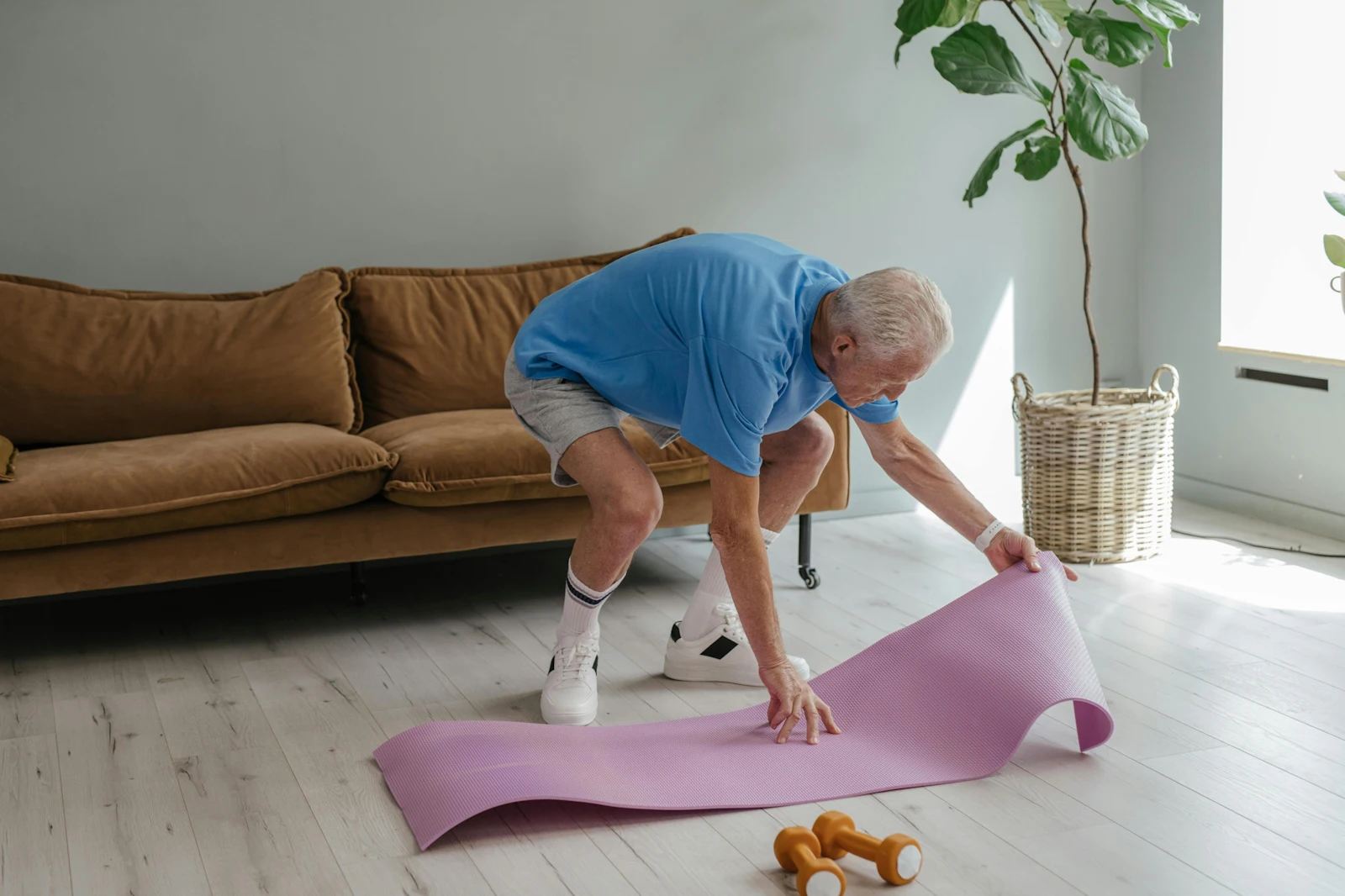
12 Balance Exercises for Seniors
These are a mix of static balance (maintaining balance in a fixed or stationary position) and dynamic balance (requiring balance while moving) exercises that can be done with little to no equipment in your own home.
It’s recommended to practice these exercises 3–5 times per week for about 15–20 minutes per session. If possible, do these exercises with supervision until you feel comfortable doing them independently.
1. Heel to Toe
Step 1: Start by standing upright, with feet placed shoulder-width apart. Place your right heel on the floor directly in front of your left toe.
Step 2: Then repeat with your left heel. Look straight ahead instead of looking down at your feet (If you feel off balance, you can use the wall for support).
Step 3: Try to do at least 5 steps in a straight line. As you progress, try not to use the wall for support.
2. Sideways Walking
Step 1: Stand with both feet together, with legs straight but knees slightly bent.
Step 2: Step sideways slowly and deliberately, moving one foot to the side first.
Step 3: Move the other foot to join it. Avoid dropping your hips as you step.
Step 4: Perform 10 steps each way. You can also step from one side of the room to the other.
3. Basic Grapevine
Step 1: Start by crossing your right foot over your left.
Step 2: Next, bring your left foot to join it.
Step 3: Attempt 5 cross-steps on each side. If needed, you can place your fingers against a wall for more stability.
4. Single Leg Stand (One Leg Stand)
Step 1: Begin by standing and facing the wall, with your arms outstretched and your fingertips touching the wall.
Step 2: Lift your left leg. Keep a slight bend in the right knee, and try to keep your hips level. Gently place your foot back on the floor.
Step 3: Hold the lift for 5 to 10 seconds. Perform 3 repetitions on each side.
5. Backward Single Leg Stand
Step 1: Stand with both feet together.
Step 2: Bend your right knee to lift your right foot directly behind you. Hold the pose for 10 seconds before returning your foot to the ground.
Step 3: Repeat with your left leg to complete a single set. If needed, you can extend your arms out to the sides to help maintain balance.
Step 4: Do up to three sets.
6. Chair Sit-to-Stand
Note: You will need a sturdy chair (no wheels) for this exercise.
Step 1: Place your feet hip-width apart and flat on the floor.
Step 2: Lean forward slightly and push through your heels to stand. Avoid using your hands on the chair arms if possible.
Step 3: Stand fully upright, then slowly lower back to your original seated position.
Step 4: Repeat 8–15 times.
7. Side Leg Raises
Note: You will need a sturdy chair (no wheels) for this exercise.
Step 1: Stand behind the chair with your feet slightly apart.
Step 2: Slowly lift your right leg to the side. Keep your back straight, your toes facing forward, and look straight ahead.
Step 3: Slowly lower your right leg, then do the same steps on the opposite leg.
Step 4: Repeat this exercise 10–15 times per leg.
8. Step Ups
Note: Use a step, either on a staircase or an exercise step. Use a step with a railing or near a wall for support.
Step 1: Step up with your right leg.
Step 2: Bring your left leg up to join it.
Step 3: Step down again and return to your original starting position.
9. Clock Reach
Note: You will need a chair for this exercise
Step 1: Imagine that you are standing in the center of a clock. The number 12 is directly in front of you, and the number 6 is directly behind you. Hold onto the back of the chair with your left hand.
Step 2: Lift your right leg and extend your right arm so it’s pointing to the number 12.
Step 3: Next, point your arm towards the number three.
Step 4: Then, point it behind you at the number 6.
Step 5: Bring your arm back to the number three, and then to the number 12. Make sure to keep your gaze straight ahead throughout the exercise.
Step 6: Switch legs and repeat the process.
10. Calf Raises (Toe Lifts)
Note: You’ll need a chair or a kitchen counter for this exercise.
Step 1: Stand straight and place your arms in front of you.
Step 2: Raise yourself up on your toes as high as you can go.
Step 3: Gently lower yourself. Avoid leaning too far forward on the chair or counter.
Step 4: Lift and lower yourself 20 times.
11. Rock the Boat
Step 1: Stand with your feet hip-width apart.
Step 2: Make sure both feet are firmly pressed into the ground. Stand upright, with your head facing forward.
Step 3: Transfer your weight to your right foot and slowly lift your left leg off the ground.
Step 4: Hold that position for as long as you can, but not more than 30 seconds.
Step 5: Slowly place your left foot back on the ground, then transfer your weight onto it. Slowly lift your right leg.
Step 6: Repeat this five times per side (you can work your way up to more repetitions as you progress).
12. March in Place
Note: For extra support, do this exercise near a counter.
Step 1: While standing straight, lift your right knee as high as you can.
Step 2: Lower it, then lift your left knee.
Step 3: Lift and lower your legs 20 times. Rest for a minute and repeat this 3 times.

Safety Tips For Starting Balance Exercises
The most important thing to consider when practicing balance exercises is your safety. With this in mind, here are some safety tips to consider:
- Stretch: Always make time to stretch before starting any exercises.
- Use a chair or wall for extra support: Especially when beginning new exercises, ensure you have a means of support nearby, such as a chair or wall.
- Clear the area before exercising: Since balance exercises can be done at home, it’s important to clear your area of any clutter or fall hazards, including rugs, cords, or shoes.
- Have adequate lighting: Ensure the area you’re exercising in is well-lit.
- Maintain good posture: When performing exercises, keep your back straight and head up to avoid injury.
- Wear loose clothing: Loose clothing allows for better mobility, comfort, and prevents overheating.
- Keep water nearby: Staying hydrated is essential during any exercise routine, even low-impact ones.
- Keep a phone nearby: Keep a phone or medical alert device nearby in case you fall or injure yourself.
- Start slow: Listen to your body and do not try to do too many repetitions at the start. Begin with fewer repetitions, then gradually increase to more over time as you feel comfortable.
- Avoid locking your joints: Be mindful not to lock your joints, like your knees, when performing exercises. Keep your knees and elbows slightly bent.
- Join an exercise program: If you struggle to create a routine or stay motivated, consider structured courses that promote balance, like yoga or tai chi. Local community centers often offer exercise classes as well that can be great to opt into for added support and accountability. However, be sure to consult with your healthcare provider before starting any new exercise program to make sure it’s safe for you and your body.

FAQ
What is the number one balance exercise for seniors?
The most commonly recommended balance exercise for seniors is the single-leg stand.
How can a 70-year-old improve their balance?
A 70-year-old can improve their balance by regularly practicing targeted balance exercises, namely those that strengthen the legs and lower body. If there is a specific medical issue causing you to lose your balance, treating the underlying medical condition may improve your balance.
Sources
https://www.lifeline.ca/en/resources/14-exercises-for-seniors-to-improve-strength-and-balance/
https://www.hopkinsmedicine.org/health/wellness-and-prevention/fall-prevention-exercises
https://thekey.com/learning-center/balance-exercises-seniors
https://www.cdc.gov/falls/data-research/facts-stats/index.html
https://westhartfordhealth.com/news/senior-health/benefits-balance-training/


